
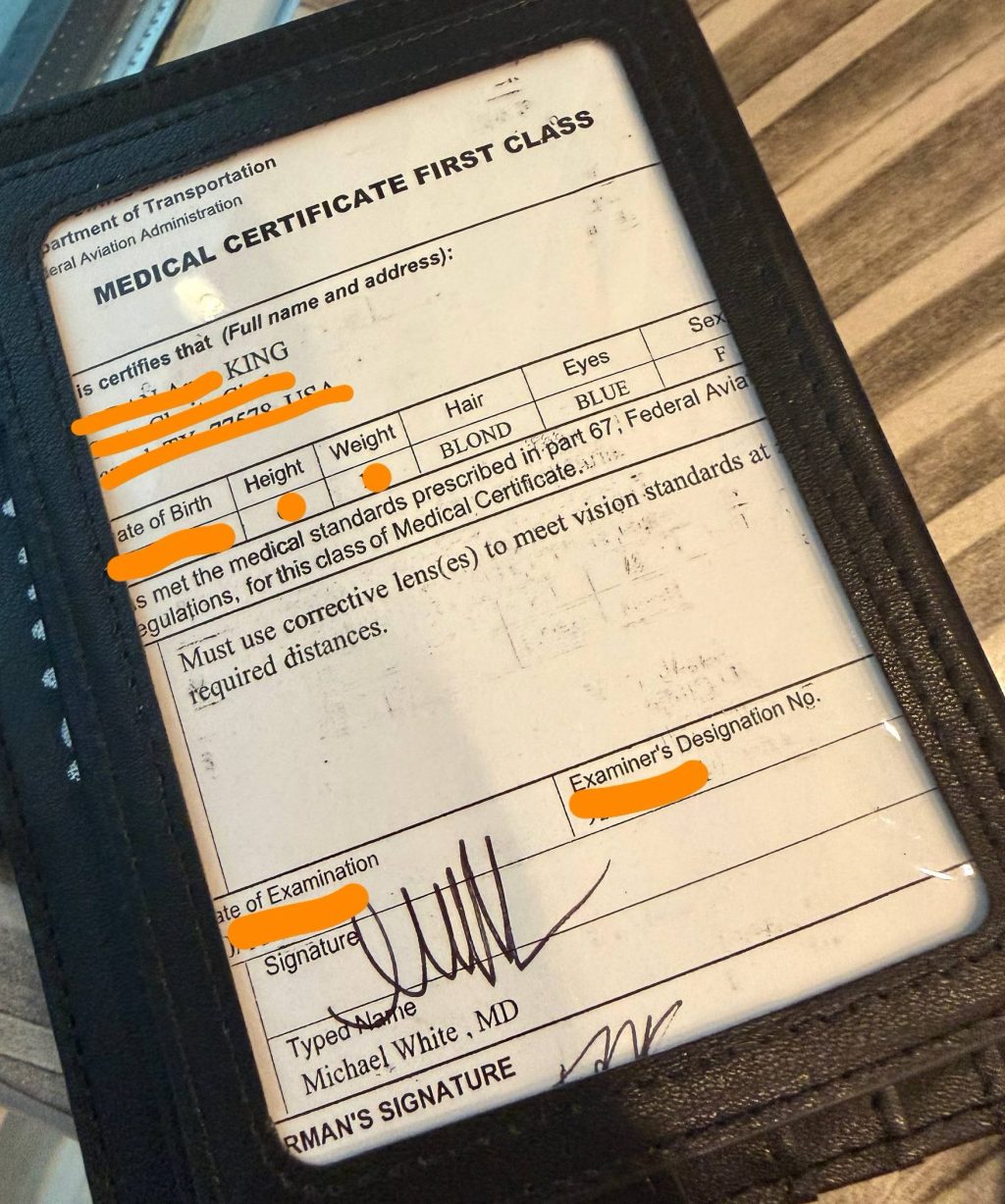
All pilots face one hurdle that is a do or die in the industry, and unfortunately it can be a career killer before you even get the chance to set foot in an airplane. There are few things worse than being stuck in “medical hell” as many of us would call it, however not all hope is lost if you have a hurdle or two to obtain a special 4″ by 6″ piece of paper.
Being a CFI myself I often find new students don’t understand the value of that piece of paper. I really will advise that if you’re an aspiring student pilot, get your medical before you begin your flight training career. The biggest reason is that if you, for whatever reason, cannot obtain a medical immediately and are deferred, you have not spent money on flight training that is now useless. Flight training in the modern era is extremely expensive unfortunately, so skipping 3-5 hours of flying now can afford you a good chunk of the fees associated with getting your medical later down the road if you happen to encounter any bumps in the road.
The “why” for a First Class
I also will suggest that an aspiring career pilot would be to get a First Class medical right out the gate. You don’t need a First Class medical as a student pilot, but it does allow you to guarantee that you are capable of getting a First Class medical, and that it won’t be a problem later down the line as you’re completing your commercial license and trying to get a job—then suddenly finding out that you cannot hold a medical that is required of a professional career level pilot.
My next piece of advice goes to parents of young folks aspiring to get into the industry… getting your child diagnosed or medicated for ADD or ADHD even while they are very young can be a career killer for both aviation or even the military. At times you will encounter having to reverse these diagnoses and it will cost an exorbitant amount of money to do so, and if your child or you are unwilling to absorb that cost you both are straight out of luck—insurance does not cover anything affiliated with aviation medicals; it will all be out of pocket. It is an extremely unfortunate truth associated with aviation medicals so make decisions now wisely because there can be serious consequences later down the line. I bring this up because there is a trend now with autism, ADD and ADHD diagnoses in children going up and often they “grow out of it” according to parents and doctors alike. But medicating your child now isn’t as simple as “good grades now” and “no consequences later”.
However if it’s a little late on the diagnoses and you NEED your medications to function, not all hope is lost! Here is an account from a friend of mine who holds a “Special Issuance” medical (they are given on a case by case basis), which relates to his experience in obtaining his First Class Special Issuance medical—
Hi there! My name is Fred G. As of the time of writing this article, I have over 600 hours of flight time and hold a commercial rating, single and multi-engine land, along with complex, high performance, and high altitude endorsements.
One of the most common questions I see that gets asked by prospective student pilots is “can I hold a FAA medical certificate with X condition?” The answer is… well, it strongly depends. The FAA is very cut-and-dry about what it considers to be disqualifying conditions. To be specific, there are exactly 15 of them. If you have ever been diagnosed with any of the following, under MOST circumstances, you cannot become a pilot unless the diagnosis is reversed or expunged:
- Angina pectoris
- Bipolar disorder
- Cardiac valve replacement
- Coronary heart disease that has been treated or, if untreated, that has been symptomatic or clinically significant
- Insulin-dependent diabetes
- Disturbance of consciousness without satisfactory explanation of cause
- Epilepsy
- Heart replacement
- Myocardial infarction (heart attack)
- Permanent cardiac pacemaker
- Personality disorder that is severe enough to have repeatedly manifested itself by overt acts
- Psychosis
- Substance abuse
- Substance dependence
- Transient loss of control of nervous system function(s) without satisfactory explanation of cause
Aside from these “dirty dozen” (plus 3), it is generally possible to obtain a medical certificate for a wide range of conditions, so long as you can demonstrate to the FAA that it is well controlled and does not pose a demonstrable safety risk. What does that demonstration entail? Again, it’s strongly depends on what you have. However, an extremely frequent one that comes up is that of a mental health condition.
If you go on Google and search up “can I be a pilot with ADHD?” or “depression” or “anxiety” or “autism” or anything of the sort, you will see a variety of answers. Many people will just tell you to throw in the towel and give up. Their negativity is not entirely unfounded, and I will get to that, but I want to set the record straight: It is 100% possible to get your FAA medical with diagnosed mental health conditions. And I should know! I’ve been diagnosed on the autism spectrum since age 3, and I was diagnosed with clinical depression at age 15. And I hold a 1st Class medical certificate now!
Now it’s time to get down to the nitty-gritty. When it comes to mental health conditions, the first two things the FAA is basically going to want to know is “how severe is it” and “do you take any medications for it”. If the answer to the second question is yes, tread with extreme caution. As backward as it sounds, a vast majority of mental health medications are considered immediately disqualifying if you take them, including all stimulant-based medications for ADHD such as Concerta, Ritalin, and Adderall. There are only eight mental health drugs that the FAA considers acceptable:
- Zoloft (Sertraline)
- Lexapro (Escitalopram)
- Celexa (Citalopram)
- Wellbutrin (Buproprion)
- Prozac (Fluoxetine)
- Cymbalta (Duloxetine)
- Effexor (Venlafaxine)
- Pristiq (Desvenlafaxine)
If you take any of these medications and want to pursue becoming a pilot, you can continue to take them! The FAA has an entire process specifically dedicated to people who are taking these antidepressants – but the only way you qualify for this path is if you only take one of these medications. You CANNOT combine them with any other mental health prescriptions whatsoever.
Regardless of whether or not you take mental health drugs, the journey is very similar – you must undergo something called the HIMS process. HIMS stands for Human Intervention Motivational Study, and it was developed specifically by the FAA in order to evaluate, manage, and treat pilots with substance abuse problems, alcoholism, and mental health disorders and certify them to return to flight. This process can’t be initiated by just AME; it has to be initiated specifically by a HIMS AME, which is a special designation from the FAA. That being said, please do note that I am *NOT* a HIMS doctor, so your experience can (and likely will) vary depending on several factors.
However, like I mentioned earlier, many pilots will often cynically say to just give up. Why? Because the process takes years (yes, not months, YEARS), and an exorbitant amount of money that you will have to shell out for visits to HIMS AMEs and neuropsychiatrists to get evaluations and the required testing done. My specific case took almost 3 years from start to finish and cost me almost $7000. And under almost every circumstance, your medical insurance will not cover a single cent of it.
If this is truly something you can pursue, however, it actually becomes fairly straightforward once you get established with a HIMS AME and secure their sponsorship of your case. The first thing the FAA is likely going to want is a complete copy of your entire mental health history. And don’t bother trying to hide or omit anything; that’s a federal crime, and if the FAA wanted to go looking, they absolutely can (and will) get access to your medical records. So just be 100% honest.
Next, they will want you to do the “golden trinity” of psychological tests. You will have to go to a neuropsychiatrist for this, and it is an all-day affair. It consists of the WAIS-IV, which is an IQ test. After that comes the MMPI-2, which is a 567-question personality test. Finally, the CogScreen-AE tests your working memory, spatial processing, reaction time, and executive function. Other tests may be requested by the FAA, depending on your specific case, but you will almost always have to do at least those three.
Once those are completed satisfactorily, and your psychological profile is generated by the neuropsychologist, everything gets sent off to the FAA for review. These are all done on a case by case basis, and nothing happens fast with them, so it takes a while. However, if you do everything that they ask for, at the end of the day, you should walk away with a fresh medical certificate, and the doors will swing wide open for you to begin your flight training journey.
If you have medical conditions or mental health problems that you are unsure about, please, speaking from experience here, get your medical out of the way before you ever step foot in an airplane. I started flight training naïvely not knowing how hard it was going to be to get my medical, and I was ready to solo and had 20 hours of flight time behind me (this can cost about $4000 or more). Thus followed a nearly 3-year hiatus from training while I got that squared away… and let me tell you, when I started again, it was like I was starting with zero hours. Flying is a perishable skill, and you have to be extremely consistent with it, especially during PPL training.
In short? Having a diverse medical history can be quite problematic for an aspiring pilot. Even if that medical history starts when someone is very young. The FAA simply doesn’t care about the when it all happened, but rather that it has at all.
Find an AME—talk to them!
Last but not least is remembering that if you have any questions, schedule a “consultation” appointment with your local Aviation Medical Examiner (AME) before you initiate filling out the MedExpress medical history online that the FAA needs you to fill out. Go talk to the doctor first! (Again insurance likely won’t cover this consultation) But the AME can likely answer any questions and give you direct guidance on how to approach your specific case since every single persons situation is different.
Need help finding your local AME? The FAA puts out a handy tool making AMEs easy to find in your local area. Feel free to ask your pilot friends or family if you know someone which AME they like to use as well, we all have our preferred person to work with.
https://www.faa.gov/pilots/amelocator
It breaks my heart every time I meet an outstanding candidate with a great mindset for aviation looking to enter the career field only to be stuck between a rock and a hard place with their medical history. Some folks I have met are a hard instant disappointment and I know how the battle will end for them, but some other individuals just have a long fight in their future and have the right mindset to push through it all for that 4″ by 6″ piece of paper.
I am not the best when it comes to the process of obtaining a medical when you have complex medical history, however I know enough to get someone started in the right direction. Very few people are willing to say how much of a challenge this can be, but it really can be the difference between someone having a rewarding experience here in the industry out the gate, or a long and expensive fight for the privilege to fly powered aircraft.
A key thing to remember is even if you can’t get your medical at all and soaring with the birds is your dream, you need no medical to fly gliders. The flight time still counts, so maybe while you’re working toward your medical with the FAA and various medical professionals you can earn your glider pilots license and learn almost everything on an airplane private pilot as well in the mean time. But talking about gliders is for another day.



Leave a comment